India
West Bengal: Collapse of the Left Front government and the way ahead for India's left
 [West Bengal's defeated chief minister, the CPI (M)'s Buddhadeb Bhattacharjee, addresses a mass rally.]
By Dipankar Bhattacharya, general secretary, Communist Party of India (Marxist-Leninist) Liberation
May 24, 2011 -- The inevitable has finally happened. The Left Front government of West Bengal, the longest-serving government in India’s parliamentary history [34 years], has been trounced quite miserably in the recent assembly elections. The defeat certainly has not come all of a sudden – all recent elections, including the 2008 panchayat elections, 2009 Lok Sabha [national parliament] elections, 2010 municipal elections and several by-elections had clearly revealed that the Communist Party of India (Marxist) led dispensation had been losing ground quite alarmingly. The April 18-May 10, 2011, state assembly elections marked the culmination of this process of decline of the CPI (M) in West Bengal.
India: The eventful life of a human rights lawyer
By Narendra Mohan Kommalapati, Green Left Weekly
May 22, 2011 -- The death of KG Kannabiran (1929-2010) on December 30 came as an anti-climax to an eventful and often turbulent life; in accordance with his wishes his family conducted a private, secular cremation within an hour of his death.
India: Protesting workers shot by company win reinstatement
 [Gorakhpur, Utter Pradesh, India. Workers at Ankur Udyog textile manufacturing company had been in dispute for wages and conditions.]
May 20, 2011, Australia Asia Worker Links -- Hundreds of workers from Ankur Udyog travelled to Delhi to participate in a May Day march and present their charter of demands to the government. Because they went to the march, 18 workers were sacked in an attempt to break the union campaign. When they returned to their factory on 3 May, they were shot by company security guards: 20 workers were injured, one very seriously.
Osama bin Laden is dead – but US imperialism’s worldwide war lives on
By the Communist Party of India (Marxist-Leninist) Liberation
May 7, 2011, ML International Newsletter -- The US has proclaimed its success in its decade-long hunt for Osama bin Laden, culminating in the killing of bin Laden by US military operatives in a house in Abbotabad in Pakistan. As the televised triumphalism and images of hyper-nationalist celebrations in the US fade, however, Washington's heroic narrative is being subjected to uncomfortable questions.
India: Mining company brands indigenous opponents 'terrorists'
From Mines and Communities.
March 22, 2011 -- An extremely serious allegation has been made against UK-listed Vedanta Resources plc.
The company is accused of sponsoring a briefing to para-militaries, employed to "safeguard" its aluminium operations in Orissa, where they were told to regard local, indigenous, opponents to the company as being "terrorists".
Note: In order to protect the security of the seasoned, Orissa-based, investigative journalist who sent us this report, we have withheld their identity.
Two hundred thousand workers march to parliament in India
 February 24, 2011, www.imfmetal.org -- In a historic March to Parliament on February 23, 2011 around 200,000 working people of India rallied in New Delhi demanding control on price rise, strict enforcement of labour laws, linkages of employment protection with the stimulus package, universalisation of social security, enhanced social security fund and to stop privatisation of central public sector enterprises.
India: Bhopal Survivors Protest Unethical Drug Trials
 Press statement by Bhopal survivors
February 24, 2011 -- Survivors of the Union Carbide disaster in Bhopal today marched to the Bhopal Memorial Hospital & Research Centre (BMHRC) demanding suspension of senior consultants involved with unethical drug trials on gas victims and compensation for those on whom drug trials have been conducted. Decrying preferential treatment of non gas victims at BMHRC they opposed attempts by the state government to take control of the hospital and demanded taking over of the administration of the hospital by the central government.
The organizations leading the march stated that senior consultants of BMHRC broke the law in 2004 by carrying out Phase III drug trials because such trials were illegal prior to 2005. They condemned the state government for not disclosing the findings of the investigation on these trials and demanded that the central government must act against the consultants who were interfering with the medical records of the trials.
India: Uranium mining destroying lives and communities
 [A labourer without protective clothing climbs a truck laden with uranium ore in Jaduguda.]
Uranium mines in Jharkhand are being run in total disregard of the health of workers and local communities, reports G Vishnu, Telhelka
September 25, 2010 -- DYAN LOHAR was born in Jaduguda, Jharkhand, with one eye, no nose and a mouth too small for his own fingers. He has nine fingers and seven toes. Now 15, he lies on a cot as his mother feeds him rice porridge in small scoops. The past 15 years of 43-year-old Kunti’s life have been devoted to a son whose worldview is expressed only by grunts and foot taps. She is angry, bitter and suffers from depression. “There are so many kids like Dyan in the nearby villages. Go disturb them,” she grumbles. We did, and found 18-year-old Mithun Patrao, who fares slightly better than Dyan — he can utter six words.
India: Community forces Dow Chemicals to abandon research and development centre
US-based Dow Chemicals has been forced to look for an alternative site for its research and development centre planned for Chakan, near Pune, after local opposition to the project. Locals were concerned about potential pollution of waterways and grasslands.
Dow Chemicals is well-known for taking over the company responsible for the 1984 Bhopal gas leak disaster — which has killed some 25,000 people — but refusing to take responsibility for cleaning up the site or providing adequate compensation to victims.
India: Towards left realignment and radicalisation
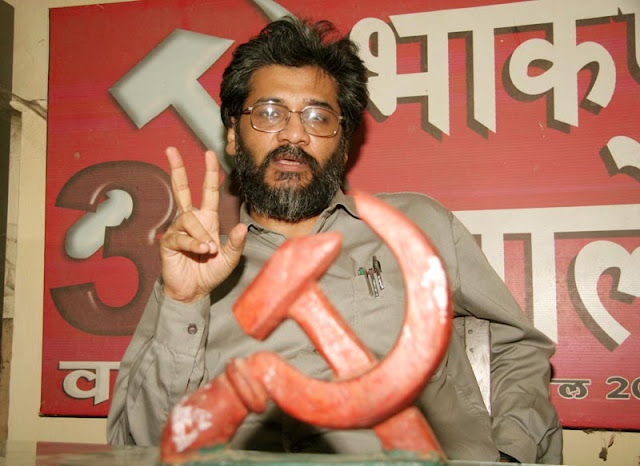 [Pictured: CPI (ML) Liberation general secretary Dipankar Bhattacharya. Photo by Satya.]
By Dipankar Bhattacharya, CPI (ML) Liberation general secretary
September 2010 -- Four fighting organisations of the left -– the Communist Party of India (Marxist-Leninist) Liberation [CPI (ML) Liberation], the Communist Party Marxist (Punjab) [CPM (Punjab)], Lal Nishan Party (Leninist) [LNP (L)] of Maharashtra and the Left Coordination Committee (Kerala) [LCC] -– formed the All India Left Coordination (AILC) at a joint convention held in New Delhi on August 11, 2010.